



High‑low‑temperature in‑situ XRD device
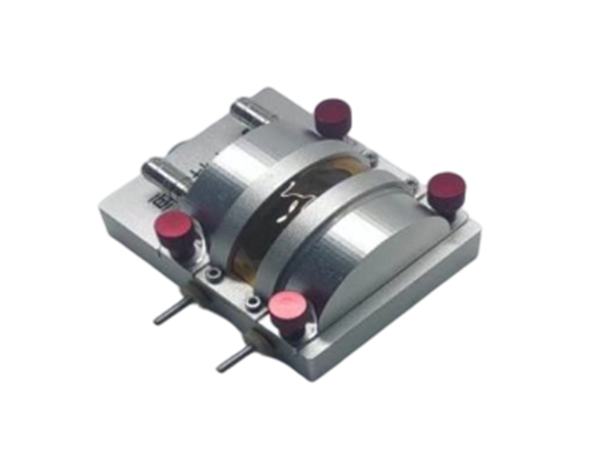
Lithium‑ion battery high‑low‑temperature in‑situ XRD test device
1、Product features
1)The device is suitable for electrochemical in‑situ XRD tests on cathode and anode materials of lithium‑ion batteries, lithium‑sulfur batteries, sodium‑ion batteries, aqueous zinc‑ion batteries and other battery systems.
2)With excellent sealing performance, the device can carry out electrochemical in‑situ XRD tests under temperature‑controlled conditions as well as XRD tests under different atmospheres.
3)Easy to operate. Adopting a unique quick‑release design, the mould can be installed conveniently with good test repeatability, which avoids experimental deviations caused by different operation methods.
4)Flexible design and good expandability. The temperature range and heating‑cooling rate can be modified according to user requirements.
5)The window can be specially customized (metallic or non‑metallic X‑ray windows) as required.
6)A multi‑channel gas mixing system is optional. Auxiliary accessories such as gas‑leak‑detection and gas‑monitoring units can be extended to realize multi‑technique combined measurement.
2、Technical parameters
1)The device consists of a high‑low‑temperature temperature controller, upper‑computer software, low‑temperature unit (liquid‑nitrogen system), high‑low‑temperature sample stage, cavity, vacuum system and other components.
2)The high‑temperature heating unit adopts imported resistance wire for direct heating. Temperature‑control range: room temperature to 200.0 °C (long‑term operation available); temperature‑control accuracy: ±0.5 °C.
3)The refrigeration unit adopts a liquid‑nitrogen cooling system. Temperature‑control range: room temperature to ‑180.0 °C; temperature‑control accuracy: ±0.5 °C.
4)The temperature‑measuring sensor is placed under the sample to truly reflect the temperature of the sample zone.
5)Overall dimensions of the device: 100 * 80 * 55 mm.
6)The device adopts an arched window structure. The window material is amorphous polymer thin‑film with thickness of 10‑20 μm. The X‑ray transmittance is higher than 95 % at 8 keV. The transmitted X‑ray intensity will not be lost at diffraction angles ranging from 10° to 90°.
7)Conventional test angular range: 2theta = 10°‑140° (minimum 5°).
8)During low‑temperature tests, the cavity is kept under vacuum or inert atmosphere. The gas flow is controlled by a mass flow meter with a measuring range of 10 sccm and accuracy of ±0.2 sccm.
9)Equipped with an adapter stage and transition bracket for the sample stage, the device can be compatible with various models of diffractometers.

